


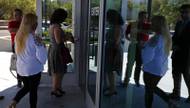

By noon on April 24, flocks of UNLV students were shuffling over to their next class when they encountered a group of dozens of peers, alumni and community members protesting just outside UNLV’s Hospitality Hall.
The event, organized by the Party for Socialism and Liberation and Youth Revolutionary Front, was meant to bring attention to the seven UNLV students whose student visas were revoked by the Trump administration this month. Members of student organizations like Students for Justice in Palestine, Latinx Grad Student Association, the UNLV Feminist Club, Philosophy Club and Sociology Society were on hand with signs reading "Education Not Deportation," "Students and Workers Unite," and "F*** ICE."
As they joined forces to chant things like, "Elon Musk, KKK, Donald Trump, they’re all the same," other students trotted along with as little as a passing glance. Some nodded in acknowledgement, while a few decided to join the fold.
Nazareth Zerai, a senior honors student studying computer science, had her feet planted firmly on the ground.
"There are so many students who are passing this by, and I think a lot of them are looking at this and want to join. They just don't know how. We need to give students a gateway. Otherwise, this complacency that's been breeding in our society as of late is going to completely tear our system down," Zerai told the Weekly.
The 23-year-old Las Vegas native wasn’t always as politically engaged as she is now. She said her decision to attend was spurred by her participation in a pair of courses that required her to become more involved outside the classroom, as well as her experience as an Ethiopian-American with many family members who remain stuck in Ethiopia after enduring years of civil unrest associated with the fallout of the Tigray War.
"I have no idea if they're going to be able to make it out. Their only hope is either Sudan, which is already overpopulated, or Europe, so long as they don't get captured. It's a really rough situation," Zerai said.
Though she was born and raised in the United States, Zerai said some of her family members back in Ethiopia have tried to immigrate to Europe but were captured and detained by "militia groups." Her background made it even easier for her to empathize with people who were living in the United States before they were deported by the Trump administration—many of which were removed without due process.
Raymond Behnke, vice president of the Students for Justice in Palestine, was one of roughly a dozen formal speakers who echoed her sentiments.
"This movement is not just about the students, it's about workers, it's about undocumented families and all these people that we can show solidarity with today—and how we can show that we have support for them. We're not going to just stand back while their due process rights and entire lives are stripped away from them," Behnke said.
Throughout the protest, adjacent issues like the Israeli-Hamas War and trans rights were also inescapable topics. Cries of fascism and human rights abuse ran rampant.
"This administration and many people are going to try to instill fear in you, they're going to tell you that if you associate with leftists, if you associate with any type of person that is advocating for immigrant rights, trying to advocate for Palestine, especially, that you're in danger," Behnke said. "That's not the case. They can only come after you if you let them do so by letting them have control over your emotions and through this paranoia that we have about organizing."
Ben Leffel, an assistant professor and researcher at UNLV’s School of Public Policy and Leadership, told the Weekly he decided to attend after hearing about the protest on social media. At the time it was initially organized, four students had already had their visas revoked. On April 21, just three days ahead of the event, UNLV announced that three more had been added to that tally.
"I think that all universities should be sanctuary campuses. We saw what Harvard did, and we should be inspired by that," Leffel said, referencing Harvard’s defiance of Trump administration demands that led the latter to pull more than $2.2 billion in federal funding from the Ivy League school. "If we are to be institutions that train our talent to be the last source of truth and good in the country, then it’s the moral responsibility of universities to protect its most vulnerable populations. We create talent, and we have to protect that talent."
Leffel, 38, said potential threats to UNLV’s research funding for noncompliance should be met with a class action lawsuit, while efforts to detain or deport students could be mitigated if the school refuses to cooperate with the U.S. Immigration and Customs Enforcement (ICE).
"Many people do not have the privilege to show their face and say their name. I do. It’s critical that we use our privilege as much as we can to protect vulnerable communities. It’s our moral and ethical responsibility," Leffel says.
As Leffel spoke to students, some wondered if he was worried that his decision to join the protest could jeopardize his job.
"No, I'm not afraid. I know exactly where I am in this fight, and I think other faculty should too," he replied.
By the time the protest was winding down, Zerai was thankful that she had a professor who allowed her to miss part of her global politics class to attend. Some of her classmates were there with her, while others discussed the issues that led to this moment in a classroom just across the street.
"I'm very, very grateful that I have gotten to learn about all of this because now I can truly be a participant in my country, and not just somebody who stands by and watches," Zerai said. "I could remain silent and maybe be a little bit fearful. But in my heart, I know the right thing to do is to speak out. If I don't share my story, then who else is going to?"
On April 25, the Trump administration began to reverse course on some of the more than 1,500 student visas it revoked in the last two months. It remains to be seen if the seven UNLV students, who the school has refused to identify for their personal safety, will be able to return to campus before the semester ends in mid-May.
