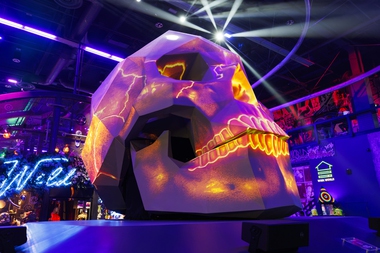
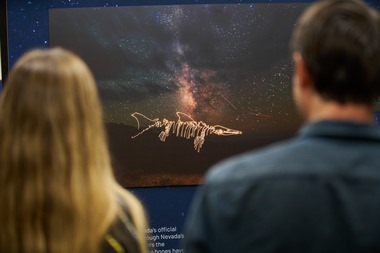
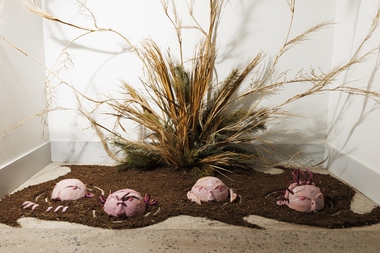
It’s quiet, almost reverently so, as I look upon Whitney Lehn Meltz’s work. Deep in the heart of Dramcorp Headquarters, the self-proclaimed “artist of oddities” has created Them, a new exhibit for Meow Wolf’s Omega Mart. Custom glyphs crawl across the walls, strange and Lovecraftian. A chandelier of hands, each forming a secret ASL message, hangs above the ceiling. It’s the space of an entity, Meltz explains, one that’s in a sort of “stasis.” At the center of the room, a hexagonal puzzle containing the entity begs to be solved, begs to be looked upon so it can begin its transformation once again.
“All of the hands on the entity are mine, and it is a sculpture of a creature that is in the act of remaking itself,” explains Meltz, Omega Mart’s exhibition art and scenic technician. “That was the main concept: How do you take a form that you have and how do you remake it? If you had the ability to remake it over and over again, why would you not take that opportunity of artistic expression to keep seeing what new thing you could make?”
Meltz has first-hand experience with transformation. Before crafting these immersive exhibits for Meow Wolf, the artist spent years in entertainment and theater, designing sets and building puppets for Vegas Theatre Company, Majestic Repertory Theatre and Cirque du Soleil. They also recently co-founded the Loose Thread Puppet Cult, which hosted its first adult puppet slam at the Fallout Fringe Festival last year. Each project, each role, has been its own evolution of artistry.
The Weekly caught up with Meltz to dig into how all these worlds collide.
What’s the personal story behind Them?
I’m non-binary, and being trans non-binary is an important part of my identity as an artist. So when making a piece of art that was going to be for a pretty big public audience, I wanted to capture that in a way that was representative of my personal feelings about it. That’s one of the beautiful things about the gender spectrum—each person’s place on it is so individual.
It started with my want to create a shrine of sorts, especially to the idea of creativity and creation. How do you make art that shapes the world? And how do you make yourself? Because I think that my experience with gender, while being an artist, is very tied up in those two things together. I see it as another form of artistic expression of what my gender is and how I present it. So I wanted to try and capture that.
You’ve worked on so many different theater and entertainment projects. Does your work here at Omega Mart feel like a big departure from those?
I would say that it’s not any different, and in some ways, I’d say that it’s so radically different. In entertainment, there is such a fleeting nature to the things that you make. You make them, some people see them, and then it goes away forever. But turning attention towards building something that is permanent in a way that not only has to be permanent but has to be incredibly durable. ... There is not an art piece that goes into this building that isn’t wildly over-engineered, because guests are really enthusiastic to test its limits. Everything might contain a secret. You’ve got to try all of it. But when you’re trying all of it, it means that there are things that just can’t be dainty and delicate. That’s wildly different from theater, where you can put a wall up with a hope and a prayer for about two weeks and say “Don’t touch it!” [laughs].
What’s the most gratifying part about finishing an Omega Mart project?
Getting to see guests interact with the exhibit. That was always the thing I loved most about scenic design for theater. You would get to make the piece of art and then you would get to go sit in the audience with the folks who were experiencing it for the first time and see it through their eyes. Sometimes I like to just dip into the room when the exhibit’s open and hear people go, “Is that ASL, is there a message up there?” And on the admittedly rare occasion where people get the puzzle open unassisted … people’s reactions when they open up the puzzle and see that there’s something in there, is so incredible. Art is worthwhile just for making it, but getting to see other people encounter it is real nice.
When did theater become a bigger part of your life?
I started doing theater in high school. I had a friend who was very much the performer type, and he very much wanted me to come be part of theater. I am not a performer type, but that is a shell that I have broken out of a little bit. … One of the two Fallout slams in June, I actually was the emcee for and I performed. That was the first time I had performed in a show ever. So in high school, they were like, “Come be an actor.” And I went, absolutely not. But do they need arts and crafts? The answer was a resounding yes.
As a puppet master yourself, do you have a favorite film or theater production that showcases the art form well?
I’m gonna tell you honestly that I have a love-hate relationship with Little Shop of Horrors. I think that it is such a seminal piece of music theater, and everyone knows it as the show with the big plant puppet. I love, love, love Little Shop. I grew up watching it. I’d go see community theater productions of it, and I’d eat it up. And then I designed and built a couple of puppets for it in grad school. And that … was a pretty humbling experience. But I can’t knock it as being the thing that started me down the path of, you know? Puppets are pretty neat [laughs.]
But I think the thing that cemented puppetry for me ... is my mentor. He also had a big passion for puppets, and he decided to put together a class where we built from scratch and we costumed, and we put tiny little wigs on, and we also built all of the props and scenery for a marionette rendition of Cinderella. That was a weird, weird piece of theater.
I’m imagining a lot.
Like, French Rococo Cinderella. And it made me go: Oh, you can just decide that something should be puppets.
Do the puppets you create ever end up getting backstories?
Most of the puppetry I have done thus far has been for pre-existing theater pieces. But actually, I’m developing a new puppetry project right now that I am super excited about, and this is the first time that I’m diving into devising the whole theater piece. My collaborators and I are coming up with the stories for the puppets as we come up with the puppets, which is also a really new wheelhouse for me. I’m a big fan of trying new things, even if they go a little messy. It’s been really interesting sort of reverse engineering the idea of, here is an object I know I want to make, and how I want it to come to life. What story justifies its existence? Which, to be honest, is a little bit more of how the space for Them was developed.
Are more puppet slams planned for the future?
We’re applying for the Puppet Slam Network Grant again, which is the funding that allowed us to put up four shows last year. …We want to spend the first half of the year offering opportunities for how to develop a short piece of puppet theater. Here’s how to build a puppet. Here’s some open mics where you can come practice playing with the puppet. We’re looking at some puppet karaoke nights, which are very much inspired by LV Puppets. We want to make sure that the pool of people who are performing in slams and coming to slams is growing, because it’s a niche art form that we want more people to engage with. We want to provide the opportunities to make sure people feel welcomed into the space to come do so.