

Inside Zion United Methodist Church in North Las Vegas is a high-tech lab ready to empower the community with education on how to grow your own food sustainably in the desert.
“We can grow with 95% less water indoors,” explains Amber Bosket, chief operating officer of the environmental consulting and research company Energy Tree, which partnered with Zion United and the City of North Las Vegas to develop the lab, called the Urban Center for Advanced Agricultural Technologies (UCAAT). Along with the 1.5-acre Zion Urban Farm, the lab will help address hunger in the surrounding neighborhood and create training opportunities.
In partnership with the church, Energy Tree has been teaching community classes on hydroponics and advanced agriculture methods since early 2022. Now, with grant funding, the Urban Center for Advanced Agricultural Technologies is ready to scale up the classes and number of students it can teach.
The $1.5 million U.S. Department of Housing and Urban Development grant was appropriated through the City of North Las Vegas, allowing Zion and Energy Tree to expand its lab space to accommodate eight students at a time and pay for other facility and equipment upgrades including microscopes and iPads.
“You’re expanding people’s knowledge [of] science and technology. If [you’re] going to grow in this box, [you] have to know the difference between nitrogen and phosphorus and potassium … copper and boron,” Bosket says.
 Energy Tree COO Amber Bosket stands near a hydroponic system inside the Urban Center for Advanced Agricultural Technologies in North Las Vegas.
The UCAAT is getting ready to launch classes in spring 2025. The intent is for people to be able to replicate these agricultural techniques in their homes and other parts of town, as well as support workforce development for commercial-scale indoor agriculture throughout Southern Nevada. The education component will be overseen by Growing Gears, which integrates science and technology in workforce development, and the University of Nevada, Reno Extension.
Wilson Ramos, community services and engagement director for the City of North Las Vegas, says there’s “empowerment” and “generational change” in training community members to grow their own food.
“This is our step into the future, allowing for individuals to learn how to sustain produce and fresh goods like this on their own. So the component of education is going to be highly important,” he says.
The UCAAT and Zion Urban Farm are situated in a neighborhood where there is limited access to healthy foods. According to Three Square Food Bank, the ZIP code where Zion is located has one of the highest food insecurity rates in the Valley at 22.6%, meaning that more than one in five residents has difficulty getting enough food to sustain a healthy lifestyle.
“We’re considered a food desert. That term is used to describe when more than 10% of the population doesn’t have access to a vehicle and lives more than a mile from a grocery store,” says Bosket, who was on the Governor’s Council on Food Security in 2018-2019.
Without access to enough healthy foods, chronic diseases are more prevalent. According to a 2017 study by the U.S. Department of Agriculture, food insecurity is “strongly related” to the likelihood of chronic disease in general. According to Bosket, the census track where Zion is located is in the 94th percentile for diabetes and the 96th percentile for low life expectancy.
“The current trajectory of where we’re at is not sustainable,” Wilson says. “We want to see our community prosper and thrive. And they can’t if these options for technologies and advancements in our agriculture aren’t there.”
Growing food in a food desert
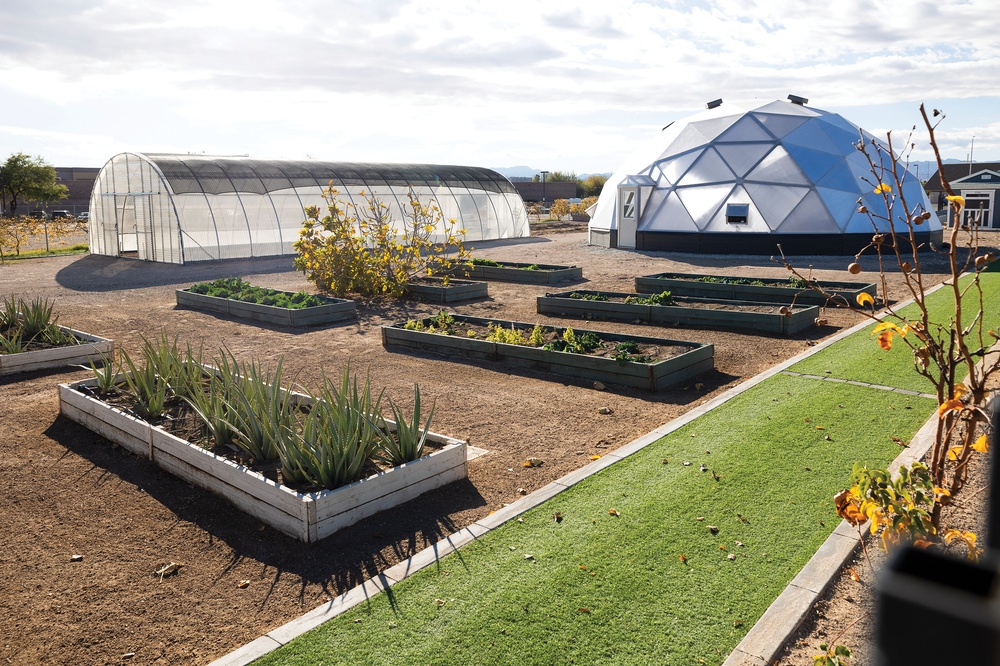
Inside a geodesic dome under development on the grounds of the 1.5-acre Zion Urban Farm on an overcast 61-degree day, it feels about 20 degrees hotter inside the dome. When the structure is completed, the temperature will be regulated to grow tropical crops.
“We’re going to create an atmosphere in here [with] fog and misting systems to keep the humidity. It’s basically the idea of solar distillation, so we can create water,” says Corrie Bosket, CEO of Energy Tree.
 Energy Tree CEO Corrie Bosket shows a geodesic dome under development at Zion Urban Farm.
With the use of advanced technologies, the dome will be a “winery for lettuce” and the perfect environment to grow strawberries, he adds.
“We’re able to increase food production in a very small square footage. And that’s our goal,” Corrie Bosket says.
Expected to be up and running by spring 2025, it could serve as a model for the region to start producing food closer to home.
Southern Nevada has never been seen as a destination for growing fresh produce. According to scientists with Energy Tree, the Mojave Desert, where Las Vegas is located, receives less than five inches of annual rainfall, which is almost 90% less than the annual average. Poor soil and extreme heat also make it difficult for traditional methods of agriculture to succeed, resulting in the vast majority of the Valley’s food being transported hundreds of miles from where it is grown.
But advanced agricultural technologies like indoor growing with hydroponics make farming possible in the desert. The Zion Urban Farm alone is capable of producing up to 4,000 pounds of sweet potatoes in a season.
Growing food closer to where it is consumed can be an effective way to combat food insecurity and its associated poor health outcomes.
Zion Urban Farm offers garden programs to seniors through a partnership with Centerwell Senior Primary Care, which works with seniors on Medicare plans, and Martin Luther King Jr. Senior Center, which is just around the corner from the farm. Centerwell has sponsored several beds at the farm, where their members can grow and harvest their own produce.
“We know that diabetes affects a lot of our seniors, and the lower income they are, the more likely they are to have some sort of chronic disease or illness … specifically because they have less access to fruits and vegetables,” says Shaun Conry, associate director of field sales and marketing with Centerwell.
“If they’re going home with sweet potatoes, kale, fresh watermelon and corn … they’re not buying snacks at Green Valley Grocery … the Dollar Generals or Dollar Trees where they’re getting high-carbohydrate and high-sugar things.”
Over the course of Centerwell’s two-year partnership with Zion Urban Farm, seniors have had access to better nutrition, Conry says, adding that members self-report feeling better about what they’re eating. He sees it as a model that should be replicated at other community centers.
“If you imagine if every church or community center in the area had some sort of way to facilitate the growth of organic fruits and vegetables, all of a sudden these people are going to have less need to go out and search for those other things,” Conry says.