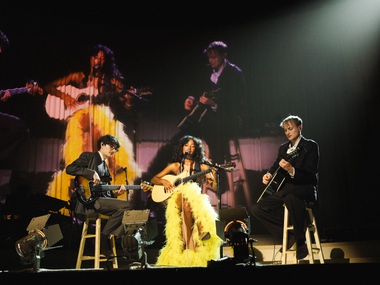

Any notable era of rock music history is time-stamped not by a block of years but by certain bands. Interpol is of that caliber. Emerging from New York City at the turn of the millennium, the band helped ignite and carry the torch for one of the most significant post-punk and indie-rock revivals in modern music.
Its sophomore album, Antics, has the power to instantly transport you to a smoky dive bar in some NYC borough, American Spirit in one hand and millennial optimism in the other. From frontman Paul Banks’ illustrious baritone to the band’s icy musical precision and tailored aesthetic, Interpol cultivated a sound and image that felt effortlessly cool. More than two decades later, it still is.
Ahead of the band’s stop at the Theater at Virgin on August 16, the Weekly spoke with founding guitarist Daniel Kessler about Interpol’s upcoming album, creative longevity and what it means to watch a new generation make these songs their own.
What can you tell us about your new album, The Mirror Weighs a Ton? How does it compare to Interpol’s older records?
One, it’s finished so that’s good, but I feel like it’s a step forward. [It] certainly feels like the next chapter ... a lot of sounds and aesthetics and atmospherics that have maybe never been a part of an Interpol record, or it’s been a long time since we’ve incorporated those kinds of sounds. Then there’s a few things that are familiar, certain kinds of upbeat songs as far as feeling like Interpol.
Summer Concerts
I’ve always liked how the band balances an atmosphere of sound and melody in this distinct way. Where do you guys pull inspiration from when you’re writing?
When I’m personally writing on songs and things like this, I’m not thinking about other music. I’m not thinking about what’s existed before, or conceptually too much. When you put us all in the room, working on these songs, it’s sort of off to the races, where we’re just thinking about where we want to take them, and performing more than actually discussing them.
It feels vital to us and important to us and urgent to us and intense, because we really care about what we’re doing. There’s so much chemistry when we’re writing ... I don’t say it’s effortless, but the creativity and chemistry is effortless.
We worked with a good friend of ours, Andrew Wyatt, who’s a great musician, great producer, and working with him, he’s like a very different force to have in the room. But he felt like a big part of the record.
After nearly three decades as a band, how have you seen Interpol’s audience evolve?
Man, it’s just so crazy to say almost three decades. The mindset is the same sort of mindset we had when we were first starting out. It’s never felt like work, and it’s never felt like something that we have to do as much as we get to do. Artistically, I think it’s really important to feel like the thing you’re currently working on is the best you’ve ever done. Otherwise, what’s the point?
It’s really bananas to look out in audiences and see people who weren’t even born when Turn On the Bright Lights came out. It’s an incredible privilege to still be doing this and to be playing shows and seeing people who probably maybe liked us on the first or second record and then they have kids, and now the kids are into us. It’s a rare place to be, and like I said, a privileged one.
To many, Interpol is considered a foundational band. What’s that like for you?
It’s nice to be thought of as a foundational band. It’s hard for me to say such, but it is nice when someone who’s you know, maybe 20 years old or a teenager and is clearly touched by our band or into our band. It’s stuff that we created so long ago, that’s somehow resonating with them, it’s really a difficult thing to do.
It’s also really incredible that all these bands that were talked about from New York in the early 2000s, their music still sounds amazing, and they’re still really talked about in the same terms. Who would’ve thought back then that it would be this 25 years later.
You played every kind of venue, from small clubs to massive festival stages, do you prefer one over the other?
I like both, truthfully, [but] I’m also kind of lazy, so sometimes I like festivals because I don’t soundcheck and just go up there and play and also the unpredictable element of just going out there on a festival stage. You don’t really know what it’s going to be like. You don’t know what it’s going to sound like. You don’t know what the audience is like. It’s a mixed bag, because not everyone’s there just to see you.
But also, when you play a small show, of course there’s the intimacy and somehow you get a little more nervous because you can really see everyone so closely and observe everyone’s movement and so forth. It brings it back to the early days, which is incredible to feel.
One of the coolest performances I've seen was the free show you guys did in Mexico City in 2024. What can you tell me about that experience?
It only got confirmed a few weeks before we actually did it, which is an extraordinary thing to do, considering that it’s a massive public space in Mexico City. We only rehearsed, I think, for one day beforehand, so we didn’t really have a soundcheck, but it was really special.
To just go out there and see this joy in the audience and this really strong connection, it was something that became very clear beyond it being such an honor to play such a historic and sacred place. To me, early on I could just see this being a personal life highlight. Not even like a career or a band highlight, you know, it’s really just like, wow, this is really an exceptional moment in my life that’s unfolding. Everything slowed down, and I made sure to savor the time out there on stage.
How do you keep this experience creatively fulfilling after all this time?
It’s not lost to me that this could just stop. ... I love writing songs as I did when I was a teenager and it hasn’t stopped, the well’s never really been dry there.
We’re only doing this because we want to be doing this. It’s a need, and that’s something we do have in common; it’s a deep need to do. And it’s a great feeling when you do come up with something new and then it gets illustrated in a way that’s so joyous to you and you’re so happy with the result, well, it’s almost like a drug and you want more of that.
INTERPOL With Julie. August 16, 8 p.m., $75+. Theater at Virgin, axs.com.