

If AI feels like an invasion from an alien intelligence, data centers are the Independence Day-like space cruisers hovering over our cities. There’s a lot of them. And their contents are every bit as mysterious as what’s inside those figurative flying saucers.
According to datacentermap.com, Nevada currently has 76 data centers: 36 in Las Vegas, 25 in Reno, 14 in Yerington and one in Elko. In April, Pew Research counted 3,000 data centers operating nationally, with another 1,500 on the way. That’s a lot of growth for an industry that doesn’t employ a lot of people on a per-site basis—oftentimes less than 200 people. Last year, the Wall Street Journal called data centers “a job-creation bust.”
Understanding these mystery boxes is vitally important, considering that virtually everyone in America may soon live near one. Let’s start small.
What do data centers do?
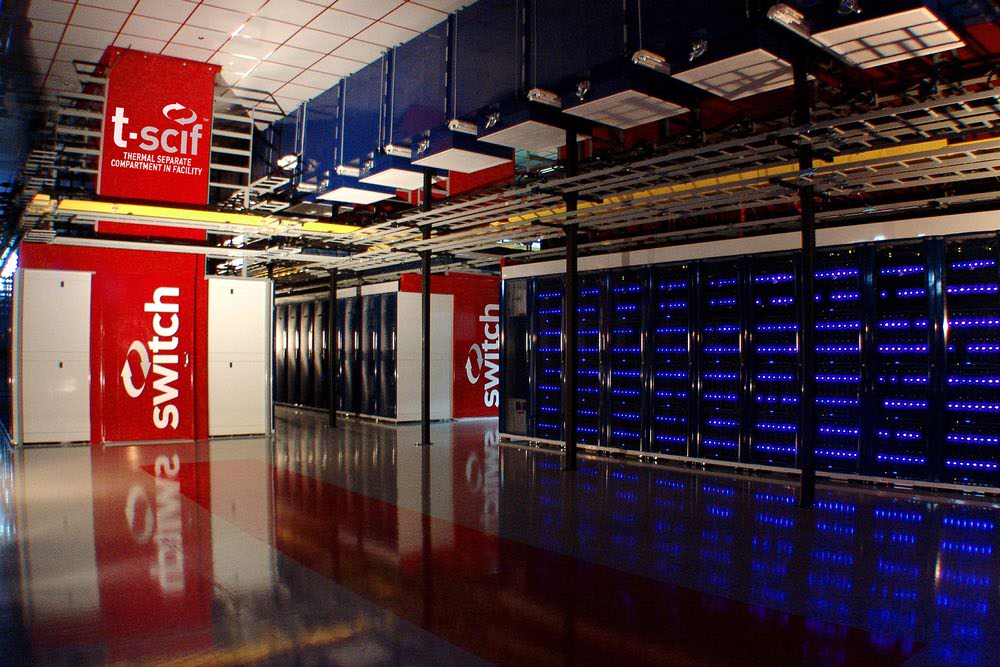
Before AI, data centers primarily served as digital storage—facilities filled with rows and rows of servers designed to store consumer and business data and applications safely and securely; warehouse-sized vaults of data. For example, Switch’s Southwest Las Vegas facility is one of these.
“Switch provides storage of information,” says Robert Rippee, former executive director of UNLV’s Black Fire Innovation Hub, now a consultant on AI. “Your healthcare information, your banking information, your credit card information … all of that is stored in data centers.”
But a GPU data center is different, using graphics processing units to handle giant computational workloads at high speeds. GPU data centers are the ones that handle AI requests. “It’s the proliferation of AI, and the applications of AI, that are creating the demand for these types of centers,” Rippee says.
Businesses and consumers are big-time thirsty for AI to run everything from search engines to mobile apps, and as long as that demand exists, GPU data centers will spread like wildfire.
Speaking of thirst
“[Servers] generate a lot of heat,” Rippee says. “You have to keep them cool to keep them functioning optimally.”
Data centers are cooled through a variety of means, including running coolant straight to the hot semiconductors—a method known as “direct-to-chip”—and immersing the servers in tanks of coolant, which is complicated and expensive. Whatever the case, you need water, and a lot of it—4.5 trillion liters of it worldwide in 2025, according to a report from the United Nations University Institute for Water, Environment and Health.
“One important thing to note about Southern Nevada … is that the Southern Nevada Water Authority has banned evaporative cooling,” says Olivia Tanager, director of the Sierra Club’s Toiyabe chapter. She adds that many data centers are moving toward a “closed-loop” system, which recycles the same water through the facility indefinitely.
“The water footprint associated with the closed loop cooling depends on the technology that the facility is using, how large the facility is and other factors,” she says. “I’ve heard some facilities are able to use the same water for 10 years.”
Overheard and overpowered
Data centers are loaded with humming machinery—servers, fans and the like. Those machines emit high- and low-frequency sounds that aren’t ear-splittingly loud. But earlier this year, the Environmental and Energy Study Institute reported that people living near a Texas center suffered migraines, nausea, high blood pressure, insomnia, vertigo and more, due to that constant hum. The diesel-powered backup generators some centers use can go as loud as 105 decibels—equivalent to a jackhammer.
While on the subject of power: According to that UN report, data centers consumed nearly 448 terawatt-hours of electricity in 2025, adding “If data centers’ electricity use were considered a country, it would have ranked eleventh globally by electricity consumption. By 2030, it could [use] 945 TWh—the world’s sixth largest consumer.”
Rage against the machine
AI has world-changing benefits if ethically applied. For example, Rippee notes AI’s ability to read an MRI more closely than humans can. Still, corporate enthusiasm for AI is creating GPU data centers at a pace that’s arguably speedier than common sense should allow.
Locally, Boulder City is now pitched in battle against the Bureau of Land Management, which re-zoned land intended for a solar energy facility for data center use. And Switch recently got Clark County’s approval for a nine-acre expansion to its southwest Valley campus.
“We see a whole lot of gusto from Gov. [Joe] Lombardo and some other folks to build data centers as quickly as we possibly can, without much thought for what the impacts look like,” Tanager says. “But there is appetite from our elected officials to address these issues. I would encourage you to reach out to folks at every level of government and let them know what it is you’re concerned about and why.”
Click HERE to subscribe for free to the Weekly Fix, the digital edition of Las Vegas Weekly! Stay up to date with the latest on Las Vegas concerts, shows, restaurants, bars and more, sent directly to your inbox!
