Almost exactly 25 years ago, in January 2001, Dana White was part of the group headed by Station Casinos owners Frank Fertitta III and Lorenzo Fertitta that purchased the Ultimate Fighting Championship (UFC) for $2 million and brought it to Las Vegas.
The tribulations and brushes with bankruptcy that followed for the next three years in the then all-but-completely-banned mixed martial arts organization are well-documented. There’s a lore about that period leading up to the first season of UFC’s The Ultimate Fighter reality show in 2005, indicating the company was always eventually going to pull through because of White’s passion for the sport.
 Brock Lesner
But that might be an over-simplification, especially when it comes to the onset.
White now says he can remember “exactly” what he was doing 25 years ago because of how overwhelmed he felt after helping convince his reunited Bishop Gorman High pals to make the UFC purchase.
For several weeks after it became final, the UFC CEO and president was tucked into a corner of the Station offices, cramming information and trying to determine how to put on a fight card immediately scheduled for February 23, 2001, in Atlantic City, New Jersey.
“Lorenzo and I knew less than zero—about production, about television and putting on an event,”
White says. “You want to talk about learning on the job? We had to dive in and start educating ourselves and figuring all this stuff out.”
Looking back, White doesn’t know if he got much right in time for UFC 30, but he is confident that he and the Fertittas quickly zeroed in on the correct goals. He famously outlined the identity they envisioned UFC developing in a 44-second segment of the broadcast.
“My first ever interview was on the show there,” White says. “I got some f**king hair and I’m saying, ‘Listen, we want to put on the biggest events in the world. We want to bring the best fighters to the UFC and make the sport fan friendly.’ Everything that I said, we’ve done.”
 Amanda Nunes
The latest part of that evolution starts on Saturday, January 24, with UFC 324 at T-Mobile Arena. The card is the first after an uncharacteristic five-week dark period for the promotion, a break that helped ramp up anticipation for the debut of the UFC’s new broadcast rights deal with CBS and Paramount.
It’s the fourth major television deal for the UFC under White’s watch, but feels like the biggest one yet—and not just because of the $7.7 billion Paramount is paying over seven years.
The new agreement also brings an end to the UFC’s long-standing pay-per-view business model, as all its fight cards will now be available free to subscribers of Paramount+, which has plans starting at $8.99 per month or $89.99 per year.
“Twenty-five years ago, (UFC) wasn’t even allowed on pay-per-view,” White says. “Think about that. Our goal was to get on TV and, here we are in ’26, with an NFL-type deal. That was our dream, our goal, our plan. So here we are.”
Twenty-five years isn’t the only milestone White reaches this year in his UFC journey. July 2026 will mark 10 years since the Fertittas agreed to sell the UFC to WME-IMG, now known as Endeavor, for $4 billion.
 From left, Frank Fertitta III, Dana White and Lorenzo Fertitta at UFC 71 on May 26, 2007 at MGM Grand Garden Arena.
It’s another moment commonly cited as a major success story for White, considering he received a $360 million payout as part of the deal in addition to a new contract to keep his job, but there’s a more complicated truth.
“I wasn’t very happy when we sold,” White says. “Everyone’s like, ‘What about the money?’ I had money. It didn’t change my life that much. I had everything I ever f**king wanted but all I wanted was to be in business with the Fertittas. They’re the greatest to this day, and the best people to be business partners with, to be friends with.”
White was despondent when Lorenzo Fertitta, who ran the day-to-day operations of the UFC hand-in-hand with him while Frank Fertitta III was consulted on major decisions, first mentioned selling. It took a series of hard conversations for White to accept that not only Lorenzo Fertitta wanted out, but that White would need to remain with the company.
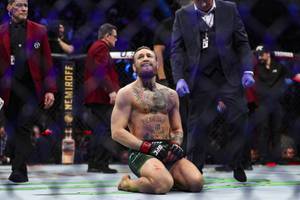
 Conor McGregor
White did get one concession as part of the talks—a say on the buyer. Despite talking to at least three other suitors and drawing at least one larger offer, White told the Fertittas that Endeavor head Ari Emanuel was the clear choice.
“I wasn’t too f**king happy about staying at the time but now, what else would I have done?” White says. “I’m really happy that it worked out. I told the (Fertittas) at the time, ‘Don’t f**king stick me with some of these guys.’ There were two guys I was comfortable with, and Ari was one of them. I ended up with Ari, and it’s been perfect.”
The price tag paid by Emanuel and his partner at the time, Patrick Whitesell, was questioned, but now looks like a bargain on the broadcast-rights contracts alone. The UFC just completed a five-year, $1.5 billion deal with ESPN negotiated by Emmanuel before securing the Paramount windfall.
 Alexander Volkanovski
White says no one other than Emanuel could have navigated the landscape better.
“I will give this to Lorenzo now, that they did the right thing and sold at the right time,” White says. “In hindsight, the timing was literally perfect. Lorenzo absolutely nailed it.”
The staggering terms of the Paramount partnership popped eyeballs with the UFC not currently in a domestic boom period. Nearly eight years have passed since the sport’s most popular fighter of all time, Conor McGregor, and arguably best fighter of all-time, Khabib Nurmagomedov, squared off to spur a record 2.4 million pay-per-view buys at UFC 229 at T-Mobile Arena.
It’s been even longer since the only other superstar on McGregor’s level, Ronda Rousey, fought to draw pay-per-view buys well into seven figures.
But White has long promised global takeover, and mixed martial arts continues to explode in popularity worldwide. The company’s biggest stars at the moment are spread all over the map with the likes of Spanish lightweight champion Ilia Topuria, Brazilian light heavyweight champion Alex Pereira, Russian welterweight champion Islam Makhachev and Australian bantamweight champion Alexander Volkanovski.
 Referee Marc Goddard stands between Colby Covington, left, and Kamaru Usman during their title fight at UFC 245 at T-Mobile Arena on December 14, 2019.
Former heavyweight champion Jon Jones relinquished his title in 2025 for a short-lived retirement to bring about the first time since 2004 that the UFC has no male American belt-holders.
That could change at UFC 324 with Colorado native and veteran fighter Justin Gaethje facing off for the interim lightweight title while Topuria takes a leave, but to many, the bigger draw is his opponent—brash Brit Paddy “The Baddy” Pimblett.
White is unconcerned with questions about the UFC’s current star power, in America or elsewhere, and describes it all as cyclical.
 Alex Pereira is announced as the winner over Jamahal Hill after their title fight at UFC 300 at T-Mobile Arena on April 13, 2024.
“You want to talk about growth in America—how about getting rid of the pay-per-view barrier?” White says. “On ESPN, you had to pay for ESPN+, and you had to pay for the pay-per-view. So now, what it costs for one pay-per-view, you get everything UFC for the entire year. Just think about what that could do.”
Paramount is giving the UFC a renewed push that could also pay dividends.
White attended the Dallas Cowboys’ traditional Thanksgiving home game, annually one of the most-watched sporting events of the year, to announce the UFC 324 card on the field live on CBS at halftime. Women’s strawweight champion Mackenzie Dern and former featherweight top contender Brian Ortega meanwhile made a cameo on CBS’ broadcast of the Golden Globes.
 Ronda Rousey limbers up before her fight with Sara McMann at UFC 170 on February 22, 2014 at Mandalay Bay.
“You’re going to start to see us popping up in more places in entertainment and stuff like that,” White says. “Paramount and CBS are so fired up about being in business with us, which is what I love. People talk about the money, but I never look at the money or any of that s**t. We’re going to end up with money no matter where we end up. I look at how enthusiastic the Paramount and CBS people are to have the UFC.”
The UFC will stage 43 events annually on Paramount+ between 13 major numbered cards and 30 Fight Nights. The Ultimate Fighter and Dana White’s Contender Series will also shift from ESPN+ to Paramount+ with the new deal.
Paramount is additionally the broadcast partner for Zuffa Boxing, which White will launch after nearly 20 years of contemplating a move into the combat sport he grew up loving. (See sidebar on page 21.)
Much of the UFC’s back catalogue is already available on Paramount+, stretching as far as the event before White and the Fertittas took over—UFC 29 on December 16, 2000 in Tokyo, Japan.
 UFC 306 at Sphere on September 14, 2024, the first sports event at the Las Vegas venue.
A young Chuck Liddell opened the card with a win over Jeff Monson before then light heavyweight champion Tito Ortiz submitted Yuki Kondo in the main event. The Liddell vs. Ortiz rivalry became the first of many to define White’s time running the UFC.
Ortiz again headlined when White and the Fertittas took over operations for UFC 30 at Trump Taj Mahal, where White struck up a long-lasting friendship with the current President of the United States.
White credits Donald Trump as the only person of influence who would stand behind the UFC back then. The relationship will pay off this year with an event that White says will surpass cards like UFC 229, the celebratory UFC 100 in 2009 and UFC 306 in 2024 at Sphere that had a $20 million production budget as the biggest in promotional history.
On June 14, the UFC will stage an event on the White House’s South Lawn after accepting an invitation from Trump.
White is already being inundated with fighters begging for a spot on the card (space will be limited with multiple title fights promised) and ticket requests (sales will not be open to the public). UFC and White House staff have completed the logistical planning, but White and his team won’t start on the matchmaking until three days after UFC 324.
The start of the Paramount era is a landmark moment for the company and deserves his full attention.
“The way I look at it is, the slate is clear,” White says. “So, 2025 was our best year ever and that means nothing to me. Now we’re going in with a new partner, and we have to prove ourselves all over again and deliver for Paramount.”
UFC 324 January 24, 2 p.m., main card 6 p.m., $351+. T-Mobile Arena, axs.com. TV: Paramount+.
Dana White and UFC make a “couple-year play” by launching Zuffa Boxing
 Dana White
Dana White has maintained a love-hate relationship with boxing for most of his adult life, and credits exploiting that dichotomy as one of his secrets to success with the UFC.
For 25 years, he’s tried to marry everything he loves about boxing in mixed martial arts while concurrently tearing down the sport’s flaws. Now the UFC CEO and president gets to apply that strategy to the sweet science itself as White debuts as a full-time boxing promoter.
Zuffa Boxing will hold its first event at the UFC’s Meta Apex facility on January 23, the night before UFC 324 at T-Mobile Arena. The card will stream live on Paramount+.
“I’ve talked a lot of smack over the years on the sport and now I’m getting the opportunity to come in and put my hands on it and try to fix it,” White says.
The first main event will pair undefeated 24-year-old Irish prospect Callum Walsh, whom White has advised for the last several years, against 30-year-old Mexican former title challenger Carlos Ocampo in a junior middleweight bout.
It’s representative of the type of fights White and his team will target with Zuffa Boxing, at least initially. White technically premiered in boxing in November when he put on Terence Crawford’s upset win over Saul “Canelo” Alvarez at Allegiant Stadium in conjunction with Turki Alalshikh, adviser to Saudi Arabia’s royal court.
But he said a fight of that magnitude was a one-off for now, a necessary partnership to help Alalshikh realize his vision of packing a stadium with arguably the two biggest names in boxing squaring off.
Alalshikh has more or less bought the sport of boxing in recent years, paying astronomical sums to stage the highest-profile fights and bringing most of them to Riyadh, Saudi Arabia.
But White says that business model can only sustain for so long. Boxing needs to develop the next generation of stars for the blockbuster fights of the future, and that’s where he hopes Zuffa Boxing comes in.
“This is a couple-year play for me,” White says. “I’m going to dial in the production, start going after the best up-and-coming fighters in the world, build them up and then, in the next couple years, build some big fights that (Alalshikh) can use in his promotion.”
 Terence Crawford, left, punches Canelo Alvarez during their super middleweight championship match at Allegiant Stadium on September 13, 2025.
White has gotten a lot of criticism from boxing’s more established promoters like Oscar De La Hoya, Bob Arum and Eddie Hearn. The old guard is particularly troubled by White and his team’s push to amend the Muhammad Ali Act, which has protected boxers’ financial and safety rights for nearly 30 years.
White is pushing the Muhammad Ali American Boxing Revival Act, which would allow Zuffa Boxing to implement its own title belts and rankings—identical to how the UFC operates.
Critics say the amendment will lead to fighters earning less money while Zuffa argues the opposite, that it will provide better pay—especially early in boxers’ careers—and increased opportunities.
“I’m working on not (responding),” the typically contentious White says of the chatter from his adversaries. “I’ll let my work in ’26 speak for itself.”
One of the most attractive amenities White can offer to members of the growing Zuffa Boxing roster is access to the local UFC Performance Institute, a world-class training facility, and its next-door annexes at Apex.
Zuffa Boxing’s first card will double as the grand reopening of the Apex, which underwent a $40 million renovation last year.
The UFC initially developed the venue next to its headquarters as a production facility for its Fight Pass streaming product, but pivoted to using it as a live-event space when the COVID-19 pandemic struck right as it was being finished.
Apex’s original form had obvious limitations, however, with a capacity of 300 people and no food and beverage licenses. The renovated version will be able to hold up to 1,200 people—though it’s currently scaled for 500 people for boxing events—and comes equipped with commercial bathrooms and concession stands.
“We didn’t even have a box office before,” UFC chief content officer Craig Borsari says during a recent tour of the facility. “This was never meant to be an event center, so we needed to catch up.”
Apex will be the immediate home to Zuffa Boxing, but White promises some surprises in the future including one that has “a lot to do,” with Las Vegas and, “bringing boxing back to this city.”
He welcomes challenges from the likes of De La Hoya and Hearn but wants to fight for his own vision of the future of boxing.
“I’m not going out there beating my chest like I’m the savior of the sport or any of that s**t, but I have a plan,” White said. “I have an idea, and we’ll see by the end of ’26 how it plays out.”
ZUFFA BOXING 01 January 23, 6 p.m. Meta Apex, limited tickets at onlocationexp.com. TV: Paramount+.
Click HERE to subscribe for free to the Weekly Fix, the digital edition of Las Vegas Weekly! Stay up to date with the latest on Las Vegas concerts, shows, restaurants, bars and more, sent directly to your inbox!