



In 1974, Ida Johnson moved to Las Vegas from Crossett, Arkansas, “a little town 3 miles from the Louisiana line,” at the behest of a cousin who was already working in the Valley.
“He said, ‘The kind of work you’re doing, you could make three times as much money in Las Vegas, so why not give it a try?’ And I did,” Johnson says. “I put my savings together, because I’m one of those people who likes being able to pay my way. I wanted to start fresh and see what the big city was like.”
She spent a few years working graveyard shifts at the now-shuttered Westward Ho Hotel and Casino until 1977, when she stumbled into a new opportunity to join the staff at an off-Strip property that had just been rebranded from The Casino to Bingo Palace. In 1983, it gained a more permanent identity: Palace Station.
Today, Johnson is the longest-tenured team member there, where she has cooked for her fellow employees in the team dining room for nearly 50 years. In that span, she’s watched the company, Station Casinos, navigate property acquisitions and closures, financial triumphs and lulls en route to gobbling up the off-Strip market in Las Vegas.
“It’s almost like seeing your kids growing up,” Johnson says of the legacy she’s quietly helped build. “I’ve been able to do things with my kids, my grandkids and my great grandkids that I would never get to do had it not been for Station and my coworkers.”
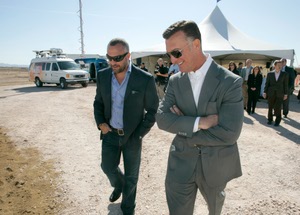 Lorenzo Fertitta, left, and Frank Fertitta III at the groundbreaking for Aliante Station in North Las Vegas, which opened in 2008. The property changed hands in 2011 after the company’s bankruptcy and is currently owned and operated by Boyd Gaming.
The company was the brainchild of founder Frank Fertitta Jr., who spent decades building it into an empire alongside his sons Frank III and Lorenzo. The next in the line is Frank Fertitta IV, who today serves as senior vice president of operations at Red Rock Resorts, Station Casinos’ parent company. His connection to Palace Station is fundamentally different from Ida’s, but no less fond.
“A lot of nights my mom would drive me and my sisters over to Palace Station to go have dinner at the Fisherman’s Broiler with my dad, who was always very adamant about having family dinners together and never really missed one,” Fertitta IV says. “I remember going up to his office and doodling on his whiteboard while he was on phone calls or taking meetings—a lot of good, happy memories.”
As Station gears up to celebrate its 50th anniversary July 1, it’s clear the company’s founding family and approximately 9,700 team members aren’t the only ones with many happy memories from time spent at its various casino and hotel properties. The organization’s uncanny ability to connect with locals has made it one of the most influential forces in Las Vegas gaming.
A DIFFERENT KIND OF CASINO
After moving to Las Vegas from Texas in 1960 at the age of 21, Frank Fertitta Jr. began his career as a bellman at the Tropicana Hotel and Casino and proceeded to spend the next 16 years cutting his teeth in the industry as a blackjack dealer, pit boss and, eventually, casino manager.
It was during the transitional decade of the 1970s—as Las Vegas was shifting away from its mob ties toward its corporate era—when Fertitta came up with the concept of a casino that would cater primarily to locals.
“He understood that when you worked on the Strip all day long, you wanted to go hang out somewhere that wasn’t really around the people that you just spent your day serving,” Fertitta IV says. “I think a lot of people thought he was crazy, and thank goodness it worked out. It was really just about taking good care of people—knowing their name, asking them about their day and how their family is—and we do our best to maintain that today.”
Fertitta Jr. served as chairman until 1993, when he passed his leadership role along to his sons, just before the company entered a rapid expansion phase. Boulder Station came along in 1994, followed by the now-defunct Texas Station in 1995, Sunset Station in 1997, the acquisition of Santa Fe Station in 2000 and the opening of Green Valley Ranch Resort in 2001.
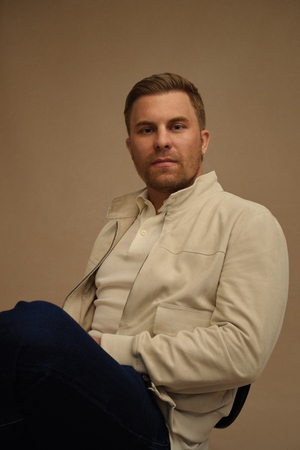 Frank Fertitta IV
For Frank Fertitta IV, nothing matched the scale of Red Rock Resort when it debuted in 2006.
“I was a big skater kid back in the day, and I remember meeting Tony Hawk that [opening] night, which I was pretty excited about. And then the Sting concert, of course,” he says. “Mostly, I remember how proud my grandfather was of my dad and his brother during that opening, and just how big of a night it was for my family.”
Although Frank Fertitta Jr. died in 2009, his vision lives on in a company that remains dedicated to maintaining the roots its patriarch planted.
“We call it the Cheers culture, where you come in and people know your name and have a smile on their face,” Fertitta IV says of the philosophy that has guided Station Casinos through five decades. “Even though the company evolves in terms of the way the buildings are built and the amenities we offer, the neighborhood-oriented, service-first culture will always be the same, and I think that’s really what [Fertitta Jr.] set out to do originally.”
THE FERTITTA EDUCATION
Joining Frank Fertitta IV in leading Station Casinos into the next half-century is Jordan Seager, who got his start there as a 21-year-old intern in 2007. California-born and Vegas-raised, he put in time at nearly every major Station property before becoming Red Rock’s vice president and general manager in January.
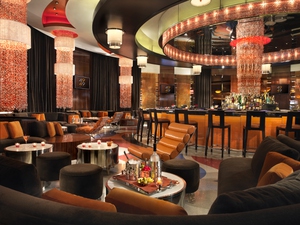 Santa Fe Station’s 4949 Lounge
“I thought I was going to go into international trade, and I really wanted to be a lawyer. But when I was in school at UNLV, a buddy of mine who got an internship with Station Casinos said, ‘Hey, it’s really awesome, you should join it,’” Seager says. “I ended up interviewing for an internship right next door to Red Rock, back when the corporate offices were still under construction. We were in trailers in a dirt lot, and the [Downtown Summerlin] mall didn’t exist yet.”
Seager showed promise early, earning an offer to stay on as an analyst. He worked in other roles like finance until 2013, when he left for a new job in the San Francisco Bay area ahead of returning to Las Vegas to serve as general manager of the Lucky Dragon Hotel through 2018. But both of those detours eventually led him right back to the company that offered him his first shot.
“It wasn’t that anything was wrong. It was just an opportunity that came up that gave me a new perspective on things,” Seager says of his time away. “I wanted to come back, and that wasn’t because I didn’t have even better offers from other companies. It was because I missed the day-to-day experience of working at Stations.”
Another draw was the good, old-fashioned “Fertitta education.”
“The ability to go from property to property and take on an opportunity that maybe you weren’t quite ready for is unique to this company. Everybody wants to grow in their business, generally speaking, but sometimes those opportunities don’t come along because you’re siloed into your little world,” Seager says. “At Station Casinos, there’s this uniqueness of not only having a lot of properties, but also a lot of different types of businesses. There are so many chances to say, hey, what are you good at, and what do you want to jump into?”
He recalls a recent conversation with a security officer who he says had amassed millions of followers as a social media influencer before opting to build a career with Station.
“They want to use the knowledge and relationships they’ve gained here to say, how do I become a junior host? How can I jump into the butler world? How can I get into the service part of the industry? To me, that is what Station Casinos is all about,” Seager says. “There’s just a piece to our business where we’re all close, and that really makes our day-to-day operating experience so much fun.”
MARBLE AND SANDSTONE
Albie Colotto has officially served as Station’s design director for a decade, but he’s actually been shaping the portfolio for far longer—helping mold the Mediterranean-inspired opulence of Green Valley Ranch and the lavish aura of Red Rock in the early 2000s with the Friedmutter Group architectural firm.
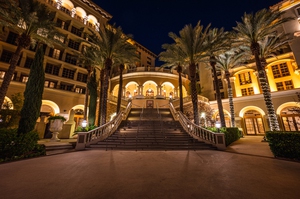 Green Valley Ranch Resort
“We really consider ourselves an entertainment company,” Colotto says. “It’s an escape. We want everyone to feel like they’re on vacation every time they come to our properties.”
More recently, Colotto played a key role in developing Station’s newest property, Durango Casino and Resort. When it opened in December 2023, the “desert oasis” represented the sleek, modern comforts that looked to carry over into Station’s future.
“When we did Durango, we really wanted to explore bringing the outdoors inside. And you could see that with the large windows and gardens right outside of them, you really feel like you’re gaming in a garden,” Colotto says.
It didn’t end there, however, as Durango is still a work in progress. In December, construction concluded on a $120 million south-end expansion that added a new bar, high-limit slot room and a 2,000-space parking garage. One month later, work began on another $385 million update to the north that will bring a 36-lane bowling alley, luxury theater, expanded restaurant offerings and entertainment venues like a country-themed live music space called Moonshine Flats.
“We’re always trying to make our projects as relevant as possible, because we don’t like to rest on our laurels,” Colotto says. “We have a great project, and it’s been doing well, but we don’t just say let’s just write that one out. We want to make sure our properties are well-kept enough that they go into that next generation.”
The company hasn’t been afraid to break a few unspoken rules along the way.
“Before, there was an old paradigm that you couldn’t have clocks in casinos, and you couldn’t have daylight coming in because no one wanted the people to know if it was day or night,” Colotto says. “We embraced it. We’re like, we want them to know that it’s bright and sunny, and you notice the difference as you’re walking around the casino. It’s all about bridging the indoor and outdoor. We’re not afraid to blur that line anymore.”
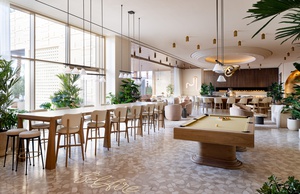 Bel-Aire Lounge at Durango Casino & Resort
This strategy has bled into older properties like Sunset Station, where the iconic Gaudi Bar closed in January for a full transformation before reopening in May—honoring its original Antoni Gaudí-inspired stained-glass architecture while introducing a modern, high-energy feel. It’s part of a $53 million refresh that’s already underway, while an additional $87 million was set aside for other enhancements like a new steakhouse, high-limit table games room, a Stoney’s Rockin’ Country venue and Leticia’s Mexican Restaurant, among others.
“We always say we have one foot in the past and one in the future. And with Sunset’s Gaudi Bar area, we have all that beautiful stained glass, but because everything was so dark in there, people almost didn’t even appreciate it,” Colotto says. “When we renovated, we said, let’s just do light plaster around it and put in a modern bar. So, we kept the bones, and they play off each other really nicely. I was out there with our general manager, and three people came up to us saying, ‘I’m so glad you kept the stained glass. It’s so beautiful!’”
Other properties are experiencing a similar evolution. Green Valley Ranch has seen nearly $200 million reinvested into completed and ongoing renovations, while another $56 million has been committed for a second phase that includes a fully refreshed casino floor and new dining and drink options.
Meanwhile, Red Rock also added to its dining offerings in May, when prominent local favorites like the style-mashing pizzeria Good Pie and viral smashburger spot With Love, Always, joined the fold.
“The first month being open inside Red Rock has been something we could have never imagined. The support from the locals has been insane,” With Love, Always co-founder and Las Vegas native Drew Belcher says. “With Love, Always is our love letter to Las Vegas, and we are honored to be a part of the Station family.”
 Sunset Station’s Gaudi Bar
This eye toward refreshing existing locations will continue to be a cornerstone of Station Casinos for years to come. But that doesn’t mean any plan is set in stone.
“I think we have trouble sticking to a blueprint, honestly,” Fertitta IV says. “In design meetings, we let our imaginations run wild, and sometimes we have to reel ourselves back in. But that’s kind of the fun part of the job—taking a new piece of land somewhere and imagining what it can be.”
A NEW ERA
As Station Casinos embarks on its next 50 years, its ambitions are backed by acreage. The company already owns approximately 454 acres of developable land scattered throughout the Valley that’s already zoned for gaming.
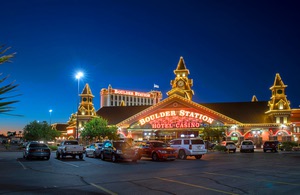 Boulder Station
“We kind of control our own destiny in terms of what comes next,” Fertitta IV says ahead of teasing that an announcement on the brand’s next property will come “in the not-too-distant future.”
For someone who never imagined himself doing anything else, the current milestone carries a particular weight.
“Being able to reflect on the last 50 years of watching it grow, and then know that you have an integral part in shaping the next 50 years—it’s indescribable,” Fertitta IV says. “I’m just happy to be here for the ride.”
Tuning into your very own Station
When Red Rock Resort opened in Summerlin 20 years ago—how has it been that long?—we knew what to expect, but we were still excited. We’d been living in the northwest part of the Valley for a long time, and while there had been stellar local casinos closer to home with the Resort at Summerlin (1999) and the Suncoast (2000), we were clamoring for our own Station.
We’d spent years floating out to Henderson to meet friends and party at Sunset Station, and then Green Valley Ranch Resort opened in 2001, the fanciest locals’ spot ever. We were so jealous of those eastside friends. But now, Red Rock was ours.
If you don’t understand why it was so exciting, you probably haven’t lived in Las Vegas very long. Station Casinos properties have a way of truly connecting to their neighbors, making it feel like something for the community rather than a huge hospitality enterprise.
At Red Rock, that manifests in a constantly changing restaurant lineup, because Summerlin folks have evolving tastes in dining. That’s why Strip-level eateries like Osteria Fiorella, Blue Ribbon Sushi and T-Bones Chophouse are there now, and why local legend Lotus of Siam opened there, and why fan favorite Hearthstone Kitchen returned.
For us, it’s the luxurious Red Rock vibes that always brought us back. At times we lived just a few minutes away, yet every visit felt like a relaxing escape to a desert spa resort we probably couldn’t afford. Sometimes we’d valet-park at the hotel entrance, just so we could enter through Red Rock’s grand lobby and have a drink at the charming bar. That’s one thing locals always need—an escape, just for a little while.
I’m sure southwest residents who’ve been settling in at Durango have similar feelings now for their own spot. Station Casinos are for us, the residents of a city where most things are not. And frequently, the neighborhood revolves around the neighborhood casino—and all its colorful, diverse offerings—the same way the rest of Las Vegas revolves around the Strip.
Click HERE to subscribe for free to the Weekly Fix, the digital edition of Las Vegas Weekly! Stay up to date with the latest on Las Vegas concerts, shows, restaurants, bars and more, sent directly to your inbox!
