

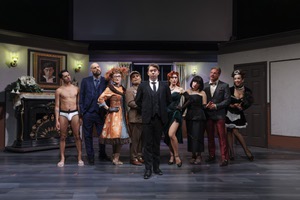
To rephrase Shakespeare, Las Vegas is a stage, and its people merely dealers—or chefs, acrobats, bartenders, dancers, Uber drivers. The Strip is our proscenium, and the surrounding Valley our backstage. When we’re “onstage” we smile and strive to convince our tourist audience that we’re partying with them; that we’re not thinking of the bills and messes we have piled up a few miles away. We don’t fill our positions so much as inhabit our roles.
Considering this, it’s not surprising that Las Vegas’ live theater culture is beginning to hit stride. It began decades ago: Super Summer Theatre was founded in 1976, Las Vegas Little Theatre in 1978, the Asylum Theatre in 1997, UNLV’s Nevada Conservatory Theatre in 2000. Our independent local theater companies—those previously named, plus Vegas Theatre Company (formerly Cockroach Theatre, founded 2003), A Public Fit Theatre Company (2013), Majestic Repertory Theatre (2016) and Nevada Shakespeare Festival (2021)—are programming robust seasons every year.
This momentum has led us to this moment, when local theater has finally earned wide respect and is on the verge of laying a foundation for sustainability. Two promising entities have recently come into being. Fallout Fringe Festival is a curated experimental theater fest featuring everything from puppets to drama to drag. And THIRD Street, a “theater incubator” taking shape Downtown, will combine education and performance in a way this city has never seen before.
Daz Weller, THIRD Street CEO and director of Vegas Theatre Company, sees the incubator—and Vegas’ theater culture, in general—as a necessary civic asset, a social good that’s “encouraging empathy.”
 Daz Weller and Ginger Land-van Buuren
“We need a central hub in this city ... a central place that connects people,” Weller says. “That’s my big mission: How do we get connected? How do we bring people together to share a story that may or may not transform the way you see the world?”
Las Vegas’ theater scene is forming into a tight network of interconnected elements from the classroom to the black box. To paraphrase Shakespeare once more, its players, and the way they’re inhabiting their roles, is the traffic of our stage. Let’s raise the curtain.
COMMUNITY OF COLLABORATORS
Theater isn’t just a communal experience for audiences. What is now forming among Vegas’ actors, writers and stage crews is akin to a theater ecosystem. The same stagehands who rigged lighting and built sets at Majestic on Saturday might be calling cues at a Vegas Theatre Company production Tuesday. Actors bounce between companies, their networks expanding with every rehearsal and every new project. Even the scrappiest, most stripped back one-person performances rarely happen in a silo. Why should they, when our talent pool grows deeper by the day?
For Gary Parlanti—a stage manager, set builder, scenic collaborator and everything in between—Vegas’ collaborative scene has always been strong. And it’s only getting stronger.
“I’ve done musicals, I’ve done horror shows, I’ve done Shakespeare, I’ve done opera. I do shows all over the city,” Parlanti says. “Right now, I’m at Super Summer Theatre for 1776. So, as I keep moving around the city, people keep grabbing me, like ‘Gary, are you available for this? Gary, are you available for that?’ I see it growing.”
 Juliana Noble
Actor and playwright Juliana Noble can attest to the importance of collaboration and getting the right people in the room. She and Parlanti just collaborated on her heartfelt family drama The Will to Live at Vegas Theatre Company. And Daz Weller is directing and producing her darkly humorous Fallout Fringe play, Can’t Save Everyone. For Noble, working with Weller again—after first meeting during his guest-direction of The Crucible for Nevada Conservatory Theatre—was something she’d been building toward for years.
“Daz was the first person who I wanted to direct my shows,” Noble says. “Every show I’ve seen of his … he’s never had a dud here. If you look back at the Eat More Art reviews, it’s five and a half stars, five stars. He’s just damn good at what he does. In college, I’d always go to his productions, and I just wanted to be a part of that.” (Eat More Art Vegas, a culture website published by Asylum Theatre artistic director Sarah O’Connell, publishes local theater reviews regularly.)
 Gary Parlanti
For both Noble and Parlanti, teaming with Weller extends beyond just a crossover of talent. It’s a crossover of influence. Parlanti says his collaborative relationship with the Vegas Theatre Company artistic director opened doors in the theater world he never expected. Prior to that, Parlanti had no experience at all.
“I had knowledge of power tools, woodworking, that sort of thing, and I really wanted to get into theater out of just this crazy dream ... how am I going to do this? How am I going to make money? I went down to what was formerly Cockroach Theatre. That’s how I met Daz, and he gave me a shot when nobody else knew who I was,” Parlanti says.
It’s those kinds of risks that drive the health of Vegas theater. In conceptualizing the month-long Fallout Fringe Festival, artistic director Breon Jenay—known for her stagings at A Public Fit—took the leap of inviting artists from around the country to come out and play.
“We wanted to open it up and let Vegas artists mingle with artists from New York and Philadelphia and Los Angeles, and form connections with them and network,” Jenay says. “To explore new avenues, make new friendships and take classes that they otherwise wouldn’t have access to.”
Downtown venues will welcome audiences and acts for the Fallout Fringe shows, extending to places like THIRD Street, Bizarre Bar, Cornish Pasty, Vegas Theatre Company, Majestic Rep and many more that you know and love. It’s a sprawling takeover, one that’s essential to any great fringe fest that’s worth its salt and serious about pulling off memorable productions outside of a traditional theater.
“It’s celebrating not only the art but the venues,” Noble says. “It encourages people to hold on to the Arts District while we still have it. Something like this kind of shows the city, hey, we do care.”
A THIRD PLACE
An inevitable side effect of collaboration is artistic growth. Annette Houlihan Verdolino—a versatile performer who’s worked with most of Vegas’ theater companies, plays the bubbly burlesque emcee Blanche DeBris and did a tour-de-force turn as an authoritarian teacher in Miss Margarida’s Way at the Smith Center—says she learned a few new things in a recent collaboration with A Public Fit’s artistic director Ann Marie Pereth.
“She’s a really good director, empathetic and sensitive,” Verdolino says. “She broke me of habits that I had I didn’t even realize I had gotten into.”
That spirit of sharing resources, of constructive feedback, is driving Weller and his collaborators—which include Vegas City Opera’s Ginger Land-van Buuren, Laugh After Dark, and magician Teller—to renovate a former cinema multiplex into THIRD Street, a multidisciplinary arts center that aims to “bring together live performance, broadcast production, education and community.”
 Annette Houlihan Verdolino
THIRD Street will incorporate live theater spaces, screening rooms, classrooms, rehearsal space and more. Las Vegas Sinfonietta, Laugh After Dark, Vegas City Opera and Vegas Theatre Company will be its companies-in-residence, but on a July 2025 walkthrough, Weller suggested opening an even bigger umbrella.
“Part of the idea is, when we get the design right, it becomes not just a hub for these four resident companies, but we can accommodate other companies and share resources,” Weller says. “It becomes a mini WeWork for the arts, so there’s this cross-pollination happening within the building.”
The possibilities of a designated space for collaboration among performing arts groups have galvanized Vegas’ arts community, as well as educators. College of Southern Nevada has agreed to give credits to students working with THIRD Street, and the incubator is in discussions with UNLV about youth and senior educational programs.
There’s about to be a lot more theater people walking around. And the existing community couldn’t be more excited about that.
“I wanted to cry once Daz toured me [around] this place,” Parlanti says. “A year ago, it felt like it was a pipe dream. I feel like it’s our own little Smith Center for Vegas locals, for the local town that’s right here. This is actually a dream come true. It’s a very, very exciting time for theater right now.”
TWO-WAY STRIP
Actor Katie Marie Jones, who balances her time at Majestic with gigs like in-arena hosting for the Vegas Golden Knights, acknowledges that the bar is set high when it comes to local theater companies performing in the shadow of the Strip.
“Because Vegas is such an entertainment town ... I don’t think most theater companies in town settle for mediocre,” Jones says. “We’re going to strive as much as possible to make that show the best anyone’s ever seen. … You might think we’re semi-professional theater, but we’re going to put on at least an off-Broadway quality show for you.”
 Emma Newton and Jeremy Dubey in Fallout Fringe Festival in 2025.
And when they’re not in the joyous trenches of local theater, many theater workers are finding well-paying gigs on the Strip. Take Verdolino, who outside of her local performances may be better known for her role in Menopause the Musical at Harrah’s. She was thrilled to do “that, and only that” for just over six years, both in Vegas and on tour. Menopause was a good, steady gig that made her lots of friends and connections, but its nightly demands didn’t leave much room for improvisation or creative growth.
“I’d love to just be able to have a place off the Strip where I wouldn’t need a day job,” Verdolino says. “My love is the grungy, Downtown, seat-of-your-pants kind of theater.”
Could happen, right? Live entertainment is one of Vegas’ most consistent audience draws, preceding sports and attractions by decades. Several Broadway shows—Chicago, Avenue Q, Spamalot, The Phantom of the Opera, The Lion King—have enjoyed Strip residencies. And much of what draws crowds night after night, from the ghouls of Universal Horror Unleashed to the horny cowpokes of Atomic Saloon Show, is grounded in straight-up acting.
Matthew Morgan, artistic director of Nevada Shakespeare Festival and a frequent Strip performer, had an epiphany while getting coffee with a friend from Cirque du Soleil.
“When you do those big shows you’re performing at people. When you do the shows at Vegas Theatre Company or Majestic you’re performing with people, for people. You can see them; you can engage them; you can change things for them. That’s almost more dangerous, and more exciting, and more fun in a way.”
If any city could be that theater utopia, where corporate money supports that kind of creative growth, it should be Las Vegas, which needs all the razor-sharp working actors it can get. But it hasn’t played out that way. Pereth once put hours into applying for a grant from a Strip gaming giant, only to get $250 and a dismissive, seemingly AI-written follow-up, she says.
“I go to theaters in Chicago and I look at their donor pages, and I see all the corporate support that is completely missing in Las Vegas,” Pereth says. “[Vegas corporations] are very interested in their own projects, and they have not taken the time to really see what we’re about.”
For Majestic’s artistic director Troy Heard, who has lived in places where that kind of giving was more commonplace, he has had to make do without that support.
“It was a shock to the system moving to Las Vegas 17 years ago and finding absolute minimal corporate philanthropy, compared to what we had in Georgia,” says Heard. “Unfortunately, that picture hasn’t changed at all.”
Verdolino says corporate help could go a long way for local theater companies.
 Katie Marie Jones in Scream’d
“I worked in corporate contributions way back. A $5,000 grant is a drop in the bucket to a casino but can make such a big difference to a small theater company,” says Verdolino. “It could mean hiring a development director for two to three months to create more momentum with donations and giving and grant writing. A lot of people running local theater companies are doing it all by themselves.”
The local scene still faces financial headwinds. And we have no regional theater company affiliated with the League of Resident Theatres, a not-for-profit collective that administers collective bargaining agreements with Actors’ Equity Association, the Stage Directors and Choreographers Society and United Scenic Artists. (Put into sporting terms that our city leaders can understand: Arizona, California, Oregon, Utah and Washington all have regional theaters. We need a damn franchise.)
Theatrical work, fulfilling as it is, is still work, and deserves to be paid. Vegas theater is rising to meet that challenge as best it can, says Verdolino, an Actor’s Equity member.
“Pretty much all the companies here are paying now,” Verdolino says. “That’s incredibly respectful and valuable. An actor can’t make a living only working in theater, unless you’re doing Broadway or a national tour. You just can’t.”
COME TO A SHOW
A New York Times feature on Las Vegas’ professional theater scene by theater writer Elisabeth Vincentelli, published last January, shined a spotlight on what many locals have always known: Our scrappy, artistically obsessed community takes the stage as seriously as any other place in the country. The main photo featured Jones, in costume as Sally Bowles for Majestic’s Cabaret.
“It was nice to actually be a part of that, but for me, it was more about the fact that this woman—who writes articles for the New York Times every day, goes into these theaters every single day and writes reviews—saw one of our shows, came to a rehearsal, and was like, what is this? This exists here?” says Jones. “She just had no idea and was so taken aback by the level of talent and the level of shows, and what we have to offer here in Vegas, because it wasn’t ever talked about.”
 The cast of Nevada Shakespeare Festival’s Hamlet
Every theater company mentioned in this story received its flowers in that NYT piece. It was, by all measures, a watershed moment. A true leap toward a bigger audience that this community has always deserved.
In 2023, we got a taste of that with Majestic’s breakout musical parody Scream’d. The musical defibrillated Majestic after the pandemic, resuscitating interest in other local theaters in the process. Who would’ve guessed Billy Loomis and Stu Macher grinding to Backstreet Boys’ “Everybody” could do that?
“In the past, I’ve heard a lot of chatter about the Vegas theater scene or Vegas theater actors and people just not taking it seriously. I get it to a point, but there are so many ridiculously talented, creative people in Vegas,” Jones says. “It is always infuriating to me when someone brings a show to Vegas and they don’t cast locals. You can cast that show 10 times over here. You just are choosing not to.”
This February, Majestic expanded two cult favorite horror productions—Empanada Loca and The Craft’d—to Los Angeles. Starring as the lead witch in The Craft’d, Jones got to experience their new audiences firsthand and prove that locals can command any stage.
“It was a great first step to show at least another city what Majestic has been doing here for 10 years,” Jones says. “When you’re doing something and it’s great in your city and people love it, it’s like, yeah, we feel like it’s good. But going somewhere where nobody has to say nice things about you, to validate your work ever, and getting similar feedback, or even honestly better feedback, it was really cool. I think it showed Troy, and the cast, and just hopefully the community, that what we do in Vegas is very special.”
Building an audience for Vegas theater means building an appetite. Shows like Scream’d do that. But so do risky, visceral horror plays like Vegas Theatre Company’s Abandon, Notoriety’s cheeky burlesque parody ClueX, and A Public Fit’s sharply produced What the Constitution Means to Me.
The hunger to consume theater must go both ways. And the ongoing Fallout Fringe Festival is a perfect sampling of everything in its most condensed and kooky form. It’s experimental theater as gateway drug. Perhaps you’ll go to your first local stage production there.
“Fringe in general has the capacity to open people that wouldn’t normally go to the theater,” says Jenay. “Get them into places that they haven’t been before … and see these shows that are new. Then be like, ‘What else is here? You’ve got another show next month?’ Maybe it’ll open up a wider audience and build the theater community even more. That’s the goal.”
Local theater now!
FALLOUT FRINGE FESTIVAL Thru 6/25, venues vary, falloutfringe.org.
NEWSIES June 11-13, Spring Mountain Ranch, supersummertheatre.org.
BLOODY BLOODY ANDREW JACKSON June 11-July 12, Majestic Repertory Theatre, majesticrepertory.com.
THE EFFECT June 26-27, Clark County Library, apublicfit.org.
CLUEX Thursday-Sunday, Notoriety Live, cluextheshow.com.
COME FROM AWAY July 10-26, Las Vegas Little Theatre, lvlt.org.
TSTMRKT July 11, Vegas Theatre Company, theatre.vegas.
Click HERE to subscribe for free to the Weekly Fix, the digital edition of Las Vegas Weekly! Stay up to date with the latest on Las Vegas concerts, shows, restaurants, bars and more, sent directly to your inbox!